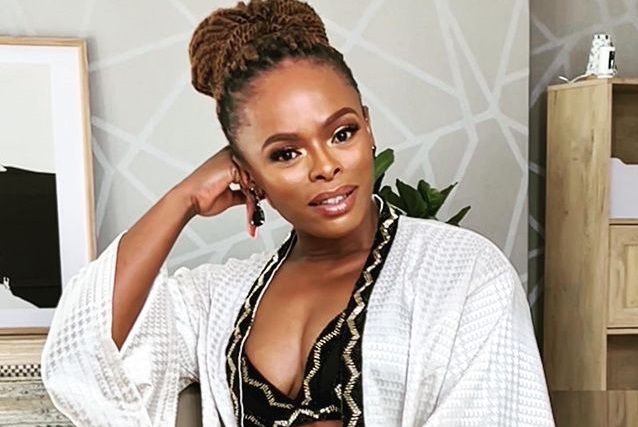
South African poet and activist Ntsiki Mazwai has sparked controversy with her social media posts questioning how fellow author, actress, and singer Unathi Nkayi secured a spot at the 33rd Havana International Book Fair 2025. Mazwai took to Twitter after Nkayi shared that she had performed for the President of Cuba upon her arrival as part of the book fair’s delegation. In a series of posts, Mazwai expressed her displeasure, claiming Nkayi, who is not primarily known as a writer or poet, was an unexpected choice to represent South Africa.
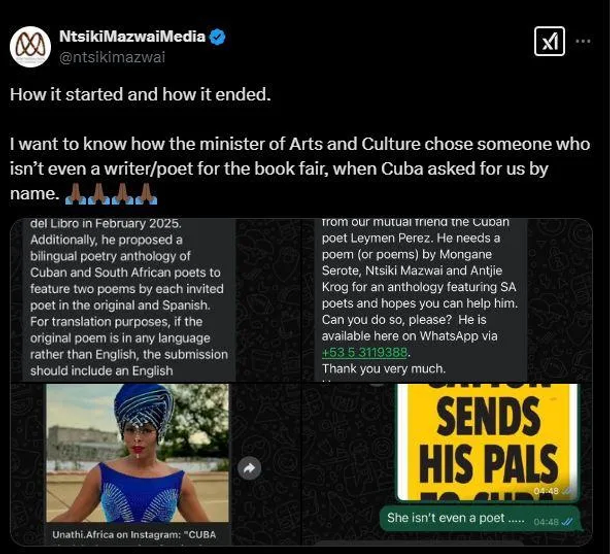
Mazwai shared her concerns about the selection process, referencing a conversation with Cuban poet and editor Leyman Pérez. She made her discontent clear, stating she was initially informed that Cuba had specifically requested her by name, only to later discover she had not been included in the final lineup. “How it started and how it ended. I want to know how the minister of Arts and Culture chose someone who isn’t even a writer/poet for the book fair when Cuba asked for us by name,” Mazwai tweeted, fueling the debate.
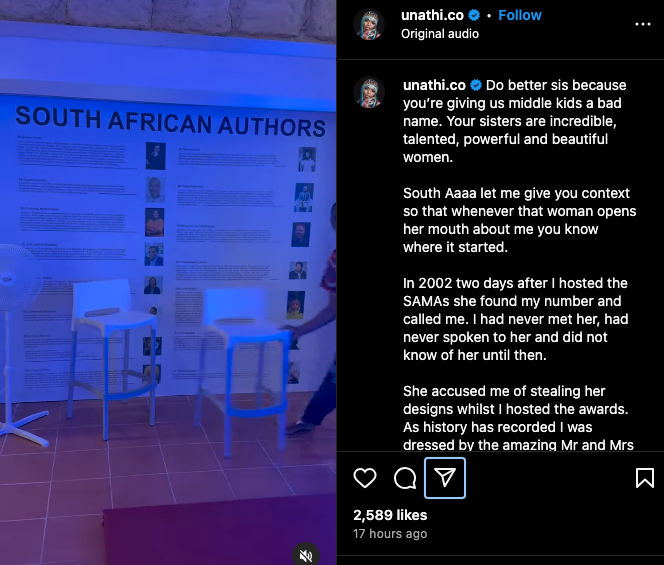
Nkayi, unfazed by Mazwai’s remarks, responded with a video posted to social media, showcasing her name on the wall of South African authors and books at the event. In the video, Nkayi confidently stated, “Thank you Ntsiki, I’m going to release my book, just for you,” as a playful rebuttal. Nkayi’s memoir, “Unathi: Memoir I Keep Learning,” co-authored with Kabomo in 2019, became a bestseller, appearing on the Top 100 list of exclusive books, further solidifying her standing in literary circles.
She also shared an Instagram post addressing Mazwai, recalling an incident from 2002 when Mazwai allegedly accused her of stealing design ideas after Nkayi hosted the SAMAs. Nkayi clarified that she had been dressed by renowned designers and had never been a designer herself, suggesting that Mazwai’s longstanding grievances with her stemmed from that time.
Despite the back-and-forth, the final delegation to the book fair, which includes poets, authors, and literary figures from South Africa, was signed off by the Minister of Sport, Arts, and Culture Gayton McKenzie. The delegation consists of names such as Farren Cloete, Sven Axelrad, Tuelo Gabonew, Boitumelo Tevin Mainganya, and Dr. John Lourens Maralack, among others.
Mazwai, who remained steadfast in her belief that her body of work spoke for itself, maintained that she had been specifically requested by Cuba to attend the book fair. She further emphasized her frustration with the Department of Arts and Culture’s choices, arguing that the decision undermined the true representation of South African talent on a global stage.
Public opinion was divided, with some defending Nkayi, pointing to her success in the entertainment industry and her literary accomplishments. Others, however, questioned the Minister’s endorsement of Nkayi, especially in light of past remarks about her public persona and future potential. The debate highlights a deeper frustration within South Africa’s cultural scene about who gets to represent the nation on the global stage and the complexities surrounding the inclusion of artists and figures from diverse disciplines.
The Havana International Book Fair continues to serve as a significant platform for writers and poets worldwide, and Nkayi’s participation as part of the South African delegation remains a point of contention. With Mazwai’s outspoken critique, it’s clear that the intersection of art, culture, and politics remains an ever-relevant conversation in South Africa’s literary community.
