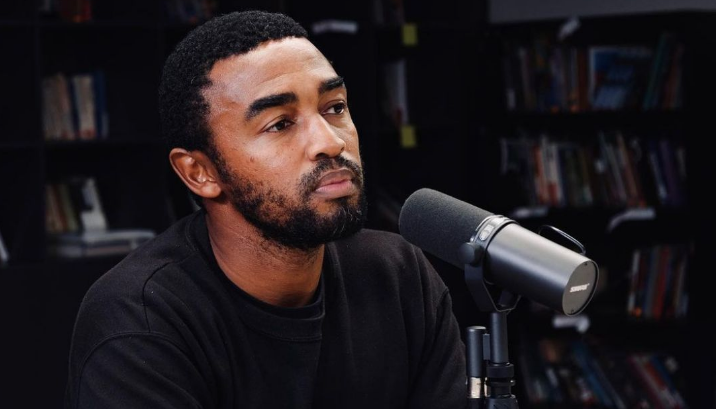
As South Africa marks Men’s Month and Movember, a growing conversation is calling for society to acknowledge the often-overlooked struggles faced by male victims of abuse. Penuel The Black Pen, a well-known South African podcaster and entrepreneur, is using his platform to shed light on the challenges of men who experience emotional, psychological, and physical abuse—and who often suffer in silence.
Penuel, who has been vocal about his own personal struggles, recently shared a heart-wrenching story about his ongoing battle to maintain access to three of his children. “I currently do not see three of my kids because the two moms refuse me access,” Penuel explained. “Luckily, I still get full access to my other four kids, thanks to the mothers. I have never violated them, nor failed to maintain my kids. The courts failed me, and I chose to walk away—to protect my mental health and to stop being an enabler.”
Despite fulfilling his parental duties and providing for his children, Penuel was denied access to three of them by the family court system. The emotional toll of being kept from his children, coupled with the public scrutiny he faced, ultimately led him to make the difficult decision to step away from the ongoing legal battle to preserve his mental well-being.
On his X account, Penuel also discussed the significant backlash he has received for speaking out about his experience. “I get attacked, mostly by women, and even some men,” he stated. “They’re not used to hearing men speak up. They don’t know what male victims look or sound like. And when you tell your story, they attack you and decide, without any information, that you’re the bad guy.”
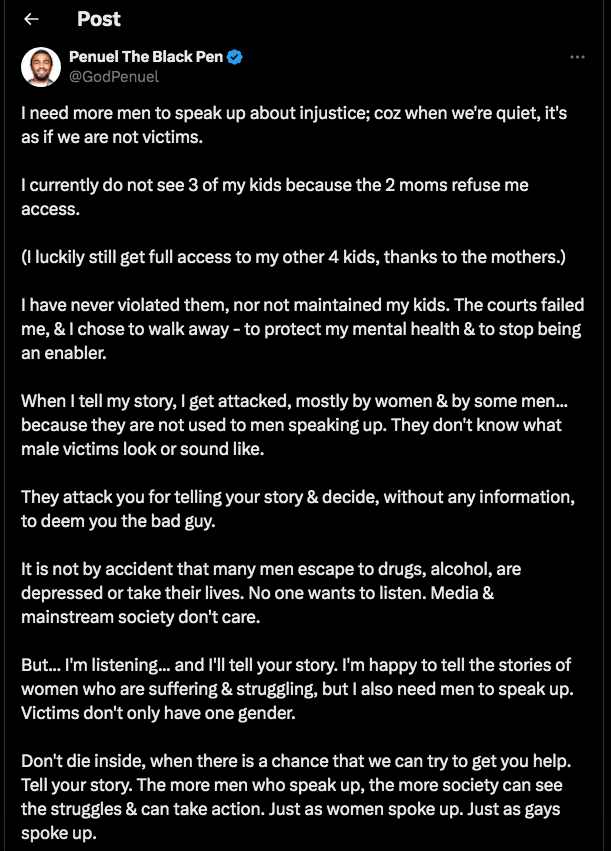
The podcaster expanded on the broader societal impact of male victimisation, pointing to how unaddressed issues can lead to far-reaching consequences. “It’s not by accident that many men turn to drugs, alcohol, depression, or even take their lives,” he said. “No one wants to listen. The media and mainstream society don’t care.”
Penuel argues that the traditional narrative surrounding abuse is often one-sided, with women portrayed as the primary victims and men left invisible in the discussion. This oversimplified view of victimhood, he believes, fails to capture the complexity of human relationships and leaves many men without the support and recognition they deserve.
“In my view, men can also be victims of abuse—whether emotional, physical, or financial,” Penuel explained. “Women can be perpetrators too.” He cited examples such as emotional manipulation, financial exploitation, and even false accusations.
