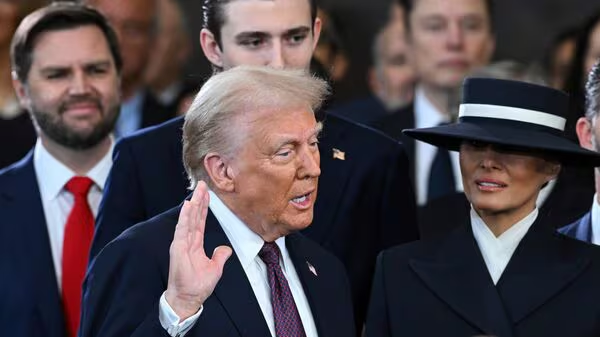
Donald Trump began his historic second term as president with a defiant and combative speech, proclaiming that the “golden age” of America had officially begun. Standing in the U.S. Capitol, Trump painted a grim picture of the state of the nation, which he said had been ravaged by a “radical and corrupt establishment” that had betrayed the American people. The speech marked the beginning of what Trump promised would be a period of restoration and renewal, one where the country would “flourish” and reclaim its place of respect on the global stage.
Trump’s tone was as bold and unapologetic as ever, describing the U.S. as a nation in decline, ravaged by years of what he called “extraction” by those in power. He promised that from this moment onward, the country’s downward trajectory would be reversed. “America’s decline is over,” Trump declared, with echoes of his populist rhetoric from his first presidential run. The 78-year-old president’s words underscored his determination to take on the political establishment and rally his base around an agenda of nationalism, economic revival, and cultural battles.
Among the first steps in this renewed vision was his commitment to a hardline approach on immigration. Trump vowed to declare a national emergency at the southern border and deport “millions and millions” of illegal immigrants, drawing loud cheers from the audience inside the Capitol Rotunda. The pomp of the ceremony, however, was contrasted by the storm of executive orders he was set to unleash immediately upon taking office, particularly targeting issues of immigration, gender, and government diversity initiatives.
Trump’s return to the White House was a notable moment not only for its political implications but also for the spectacle surrounding it. His inauguration, which was held indoors due to the cold weather, was attended by an array of the world’s wealthiest and most influential figures, including tech moguls like Elon Musk, Mark Zuckerberg, Jeff Bezos, and Sundar Pichai. Musk, a major backer of Trump’s campaign, was expected to spearhead cost-cutting initiatives in the new administration, cementing the close ties between the president and Silicon Valley elites. Trump’s relationship with these tech billionaires highlights the shift from his outsider status in 2017 to a figure now firmly embedded within the economic power structures of the country.
This inauguration, unlike his first, was marked by an unusual sense of tradition. President Joe Biden, who had been defeated by Trump in the 2024 election, was present at the ceremony and offered his predecessor a cordial welcome. Biden had previously refused to attend Trump’s 2021 inauguration, citing the false claims of electoral fraud propagated by Trump and his supporters. This time, however, the tone was more diplomatic, with Biden joining former presidents Barack Obama, George W. Bush, and Bill Clinton at the Capitol, while some notable absences—like Michelle Obama’s—drew attention.
In keeping with tradition, Biden also extended a number of preemptive pardons in the final hours of his presidency, shielding family members and political allies from potential legal challenges. He notably pardoned former health advisor Dr. Anthony Fauci and military leaders involved in the January 6 Capitol insurrection investigations. Biden also left behind a letter for his successor, which he said contained private sentiments that would remain between him and Trump.
As Trump took the oath of office for the second time, he became only the second U.S. president in history to return to the White House after being voted out of office, a distinction he shares with Grover Cleveland, who served non-consecutive terms in the 19th century. His presidency, now shadowed by ongoing criminal investigations, including charges related to paying hush money during the 2016 campaign, was not without controversy. The moment of triumph, however, overshadowed the legal challenges Trump faced, and it remains to be seen how these will play out in the coming months.
Internationally, Trump’s return to the presidency is likely to create a ripple effect, especially in the context of foreign policy. He has already signaled his intent to disrupt global norms with a range of bold actions, from tariff policies to a more isolationist stance on U.S. involvement in Ukraine. Russian President Vladimir Putin, who had congratulated Trump ahead of the inauguration, expressed openness to discussions on the Ukraine conflict, hinting at a potential shift in U.S.-Russia relations under Trump’s leadership. World leaders and analysts alike will be closely watching how Trump’s unpredictable nature shapes the geopolitical landscape.
For his supporters, Trump’s second term represents the fulfillment of a vision that promises to restore American greatness by dismantling the policies and legacies of the previous administration. For critics, it signals a return to the divisive, confrontational style of governance that characterized his first term. Whatever the outcome, the next four years under Trump’s leadership will undoubtedly be marked by significant political and cultural upheaval, as he seeks to reshape the nation in his own image.
